
Jonah Naplan February 8, 2026
Comedy always comes in threes, which is why we can finally laugh now that this bizarre trilogy of “Strangers” prequels has come to a close. What began as a cheap attempt to expand the world of a second-rate horror franchise has become an insufferable exercise in trite filmmaking with hollow characters and predictable jumpscares, offering backstories to killers who were only ever scary—if scary at all—because we didn’t know their motivations. After the awful rehash of Bryan Bertino’s original that was “Chapter 1” and the dull filler that was “Chapter 2,” now we have “Chapter 3,” which is maybe the meanest of them all. Director Renny Harlin has a few new things to say this time around and a handful of interesting ideas scattered here and there, but it’s still pretty bottom-of-the-barrel entertainment, a trashy closer to a trilogy that people will only remember as a joke, if it’s even remembered at all.
Opening immediately where the last one left off, Maya (Madelaine Petsch) is still on the run after killing Pin-Up Girl (Ema Horvath), but she won’t get very far before the remaining two Strangers catch up with her. An early scene in a chapel explores one of the movie’s sole interesting ideas about why we kill, explained by Maya’s psychopathic stalker Gregory (Gabriel Basso), but “Chapter 3” doesn’t get the chance to dive deep into it before it’s distracted by something else, such as a new plotline about the sketchy town sheriff (Richard Brake), revealed to be Gregory’s father and, in one way or another, the mastermind behind the creation of the masked trio and so many of the infamous murders that have occurred in this sleepy small town. When Maya’s sister (Rachel Shenton) arrives from Portland with a search party, the intents of the community reveal themselves to be a malicious joint effort to drive out non-locals.
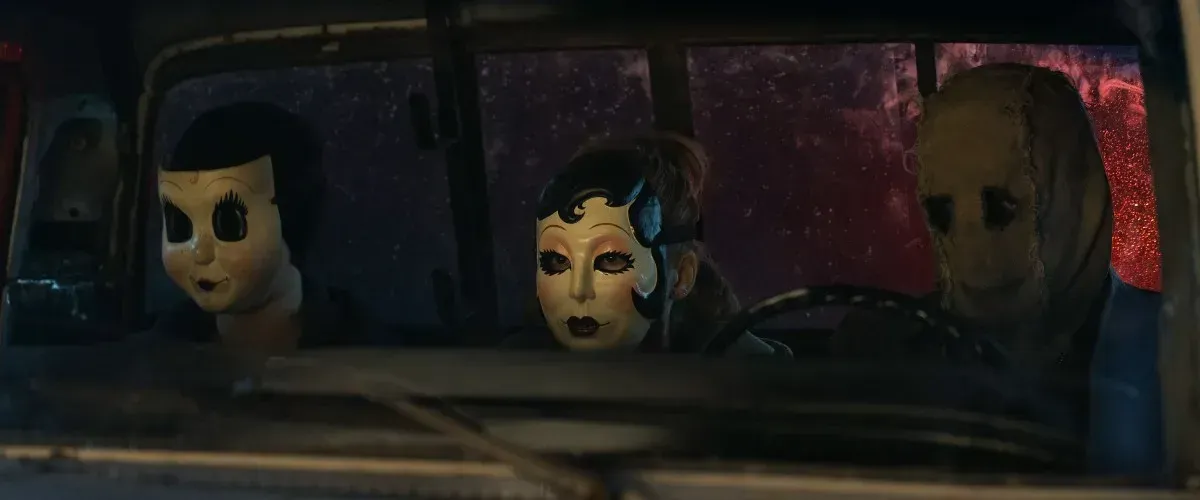
Then “Chapter 3” shifts to become a sort of twisted “Strangers Crash Course,” à la “Men in Black” or “The Matrix.” After capturing her and knocking her out, the killers put the mask on Maya and make her the “new” Pin-Up Girl, guiding her through the checklist of how to be a serial killer. It’s off-kilter and irreverent, with the potential to turn into something really fun. But it gets undermined by the dour subtext lurking underneath this whole trilogy. If the original “Strangers” was effective at all, it was because of the mystery and randomness of the murders—not knowing the killers’ motivations made them exponentially scarier. But writers Alan Freedland and Alan R. Cohen have made it their mission with these movies to explain the backstories of the Man in the Mask and Dollface and perhaps put rhyme with reason to identify a clear motivation.
There’s even scenes in “Chapter 3” of the killers as teens, developing their psychotic livelihoods and committing their first murders. The way Harlin frames these up-and-coming monsters is probably just as cheesy as a franchise like this could ever afford to be, yet it somehow isn’t any fun. The whole midsection of “Chapter 3” is a bore to get through, clear evidence of a prequel narrative that might have worked in just one movie, but is a chore to endure when stretched out across three. Ironically, even if the backstories were appropriate, they’re so poorly acted and paced that the humanity wouldn’t shine through anyhow simply because of the bad filmmaking.
Petsch remains the strongest part of these scattershot movies. Despite all of the mindless twists, turns, bemoaning monologues, and killings in “Chapter 3” (to give it some credit, gorehounds may finally find the brutal violence they’ve been looking for at the beginning and end of this trilogy closer), she stands strong, even if, by this point, her low-tolerance for this nonsense is becoming visibly apparent; she’s rolling her eyes along with us. You can see flickers of somebody who might have become a badass horror heroine in the third act of this movie, if only the narrative she’s stuck in were more concise.
If the goal of this trilogy was to make the original movies scarier, then the filmmakers failed. If the goal was to reboot the franchise’s popularity, then they failed there, too (just look at the box office numbers). We can’t be sure what the ultimate intent of the project was, but I don’t know that there’s been another franchise this decade that’s felt more like a snake eating its own tail. All we can do is smile because it’s over and cry because it happened.
Now playing in theaters.