
Jonah Naplan March 7, 2026
Now that Maggie Gyllenhaal has managed to write, direct, and produce her own passion project “The Bride!” she can now realize that her passions may be better off spent somewhere else. Falling in line with Hollywood’s recent obsession with Mary Shelley’s source material, this movie faces the misfortune of being released mere months after Guillermo del Toro’s mesmerizing “Frankenstein” adaptation, which ought to be remembered as a definitive one. “The Bride!” on the other hand, is an artistically bold but altogether bizarre project that ends up painfully dull despite every single second of the movie working so hard to convince you it’s anything but that. It’s the fault of none of the actors, but rather the result of a disjointed screenplay that needed Victor Frankenstein himself to come along and shock more life into its bones.
In its time-hopping, genre-fusing way, “The Bride!” includes an exclamation point in the title as just one of its performative devices. This is a loud, abrasive, and maximalist movie that takes all the big swings that it can muster without considering the advisability or effectiveness of any of them, and if its central message works at all, it’s because of the remarkable talent both in front of and behind the camera which otherwise gets wasted amidst this frenetic muddle of unfocused ideas and cinematic menagerie. We see style over substance in movies all the time, but this is one of the more extreme examples.
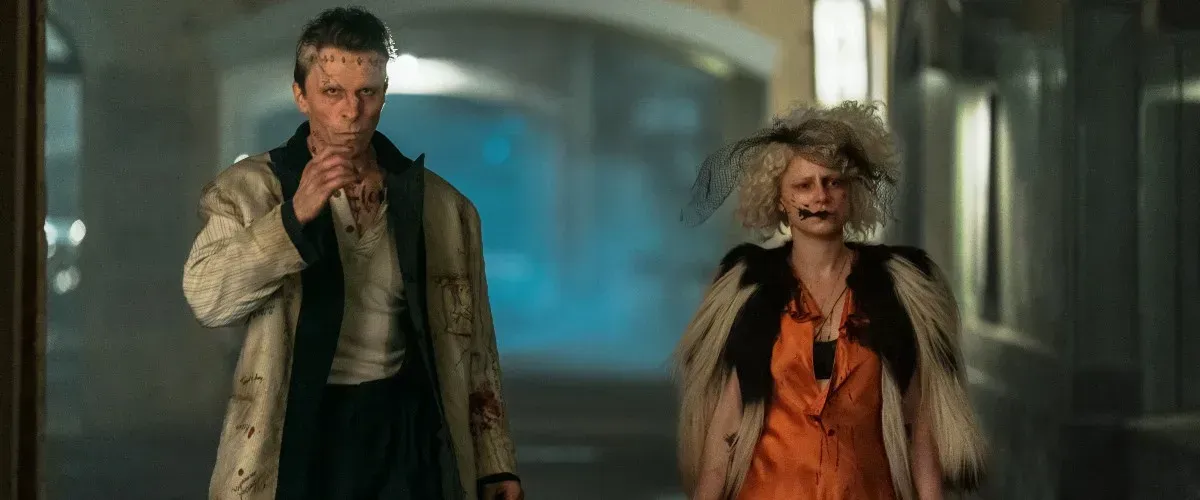
The story opens in 1930s Chicago, where a feckless Ida (Jessie Buckley, the current Best Actress frontrunner for her performance in “Hamnet”) gets wasted at a restaurant one night after being exploited by a group of sketchy men, then falls down a staircase, hits her head, and dies. Meanwhile, Frank (Christian Bale)—the infamous creation of Dr. Frankenstein—arrives in town, desperate for a companion. His desire is simple: he wants somebody, needs somebody, a partner to grant him the human experiences and sensations that he’s been lacking. He begs the zany Dr. Euphronious (Annette Bening) for her help in this endeavor, and after much persuasion, they settle on the perfect specimen in Ida’s corpse, which they dig up and bring back to the Doctor’s lab. After she gets reanimated in a sequence of surprisingly tame visuals and even more cowardly editing, Ida is reborn as a revitalized figure of adventurous and sexual hubris with mad scientist hair and an inky black splatter on her face. Surely, she’ll match his freak.
In a dynamic powerplay, the duo takes the city streets by force, running freely amok like Bonnie and Clyde or Harley Quinn and Joker, and the first act of “The Bride!” is its strongest section as they engage with the attractions of the urban environment. The pair are being guided or rather possessed by the spirit of Mary Shelley (also played by Buckley), who exists only in imagination but regularly chimes in from her black and white world of shadows and crystal balls. This extra layer added onto Gyllenhaal’s already overcrowded screenplay had real potential to play around with spirituality and say something valuable about how our creators always leave a part of themselves in their creations (intensified by Buckley portraying both roles), but it never really goes anywhere and the continued cut-away narration ends up repetitive rather than meaningful.
Frank and the Bride’s honeymoon soon comes crashing down, however, when a drunken brawl results in two dead bodies and blood on their hands. They flee to New York City, with a determined detective (Peter Sarsgaard, Gyllenhaal’s husband) and his able-bodied secretary Myrna (Penélope Cruz) hot on their heels; as the movie’s secondary duo, they start to mirror the dynamics of the monsters as it moves along. During their escapade, Frank and the Bride, who soon names herself Penelope Rogers, start to find solace at the movie theater, where matinee idol Ronnie Reed (Jake Gyllenhaal) headlines most of the pictures. Chaos at one of Reed’s own parties climaxes in a bizarre song-and-dance number where bodies are twisted in intense choreography like a pretzel, and in due time Penelope has inspired a public uprising; women are featured with face splatters of their own in a movement straight out of “Joker.”
It’s clear that Gyllenhaal has studied the former movie’s sequel, too, because the classical, Astaire-like gravitas of the musical sequences seems to be an annotation on “Folie à Deux,” and not all that much better than it. Contrast that with the mechanics of this imagined 1930s, and the movie can’t seem to decide what sort of era it wants to exist in, either. Gyllenhaal’s frustrating script toys around with the gender politics of the time but never settles on what it wants to say exactly, and the conclusions that it does reach seem conservatively questionable.
For one thing, Penelope’s movement appears to be predicated on notions of individuality and feminine character, yet she declares rather enthusiastically in the third act that she’s rather satisfied with just being “The Bride,” the sort of label that would seem to contradict her objective. This idea is further cemented in the headstrong Myrna—a hispanic woman, mind you—who Gyllenhaal has blatantly preach about the movie’s themes in the third act, and the direction her character takes in regard to her relationship with the head detective isn’t effective because you can spot it coming from a mile away.
Everything comes crashing down in the final thirty minutes, when Gyllenhaal tries to wrap everything up in a neat bow all while leaving the audience with a social-political message to chew on, and really flexing her Romeo & Juliet muscles. A couple of last minute revelations and monologues don’t have the desired effect because they arrive so late and ultimately get rushed in the midst of everything else, while the theatrics of the finale seem overly intent on reminding us that this is, still, a Frankenstein movie, even though it would have worked wonders on its own so long as Gyllenhaal had afforded it a stronger script and a bit more of a comprehensive worldview. More focused, introspective direction certainly couldn’t have hurt, either.
What a tragic waste of so much sensational talent. The worthy ensemble can only pull so many tricks from up their sleeves before the lackluster plotting diminishes their efforts. It’s plain as day that Gyllenhaal is enamored by this art form, and “The Bride!” is, at times, an implicit love letter to film itself. If only we could feel similarly passionate about the movie and just as connected to the characters, who are dead in actuality but should feel more alive on the screen.
Now playing in theaters.